

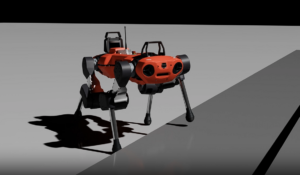
Robot and deformable body dynamics simulation plays a vital role in various fields, including robotics, industrial automation, and intelligent manufacturing. In practical applications, robots must not only perform complex articulated motions but also interact with their surrounding environments and deformable objects, such as robotic manipulators grasping flexible objects, robots handling cloth, and soft robots performing locomotion. These applications require numerical simulation methods that provide high stability, computational efficiency, and physical accuracy. Extended Position-Based Dynamics (XPBD) is a constraint-based simulation method that introduces constraint compliance and Lagrange multipliers to address the dependence of constraint stiffness on simulation timesteps and solver iterations in traditional Position-Based Dynamics (PBD). XPBD can be applied not only to robotic joint and contact constraints but also to the simulation of deformable bodies, including cloth and flexible materials. Furthermore, the constraint-solving process in XPBD offers significant opportunities for parallelization, making it a promising approach for high-performance GPU-based dynamics simulation.
The objective of this thesis is to implement and optimize an XPBD solver within a C++-based multibody dynamics simulation framework, utilizing GPU parallel computing to improve the computational performance of robotic and deformable body simulations. The work begins with an investigation of the mathematical foundations of XPBD, followed by the implementation of constraint-solving algorithms for rigid body joints and deformable body elasticity. Subsequently, GPU parallelization strategies are developed using CUDA, focusing on parallel constraint processing, efficient data structures, and minimizing data transfers between the CPU and GPU to improve simulation performance. Furthermore, collision detection and contact response between robots and deformable objects are investigated through representative robotic simulation scenarios, such as robotic manipulators interacting with cloth or flexible objects. Finally, the GPU-accelerated XPBD solver is benchmarked against CPU implementations and traditional PBD or other iterative solvers to evaluate its numerical stability, constraint accuracy, convergence behavior, parallel scalability, and computational efficiency.
Keywords: Robot dynamics simulation, contact, deformable body, GPU
Requirements:
- You are studying Robotics, Electrical Engineering, Automation, Computer Science, or a related field.
- You have a strong interest in robot dynamics simulation or game engines; ideally, you have studied robotics dynamics or multibody dynamics.
- Ideally, you have programming skills in C++.
Relevant Literature:
- Mercier‐Aubin, A., & Kry, P. G. (2024, December). A Multi‐layer Solver for XPBD. In Computer Graphics Forum (Vol. 43, No. 8, p. e15186).
- Müller, M., Macklin, M., Chentanez, N., Jeschke, S., & Kim, T. Y. (2020, December). Detailed rigid body simulation with extended position based dynamics. In Computer Graphics Forum (Vol. 39, No. 8, pp. 101-112).
- Macklin, M., Storey, K., Lu, M., Terdiman, P., Chentanez, N., Jeschke, S., & Müller, M. (2019, July). Small steps in physics simulation. In Proceedings of the 18th annual ACM siggraph/eurographics symposium on computer animation (pp. 1-7).
- Macklin, M., Müller, M., & Chentanez, N. (2016, October). XPBD: position-based simulation of compliant constrained dynamics. In Proceedings of the 9th International Conference on Motion in Games (pp. 49-54).
- Müller, M., Heidelberger, B., Hennix, M., & Ratcliff, J. (2007). Position based dynamics. Journal of Visual Communication and Image Representation, 18(2), 109-118.
Betreuer: Shao, Email:
