

Introduction
Technical systems are increasingly evolving into complex cyber-physical systems. In the context of Industry 4.0, these systems are commonly represented by Digital Twins, which provide a structured and semantic representation of assets, including their data, behavior, and interactions.
Different standards have emerged to describe and implement Digital Twins, such as the Asset Administration Shell (AAS), the Web of Things (WoT), and Azure Digital Twins using the Digital Twins Definition Language (DTDL). While these standards differ in their technical realization, they share similar core concepts, including properties, actions or operations, events, and relationships.
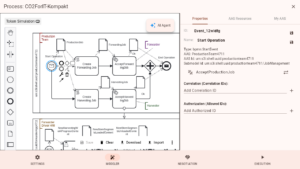
A process-driven approach based on BPMN 2.0 has already been developed and successfully applied for modeling and executing the behavior of AAS-based Digital Twins. This existing solution enables the modeling, automation, and observation of Digital Twin interactions using a process engine.
Process-driven approach
Process modeling languages such as BPMN 2.0 allow the visual description and automation of interactions within complex systems. They offer a clear separation between behavioral logic and technical implementation, making them a promising abstraction layer for Digital Twin behavior.
While the existing solution demonstrates the feasibility of process-driven execution for AAS-based Digital Twins, it remains an open question whether the underlying modeling concepts and execution mechanisms are generic enough to be transferred to other Digital Twin standards. In particular, standards such as the Web of Things and Azure Digital Twins define similar interaction concepts but expose them through different APIs and modeling constructs.
Objective of the Thesis
The objective of this Bachelor’s thesis is to analyze the differences of DT description standards and by that, to evaluate the transferability and generality of an existing BPMN-based process modeling and execution approach that was originally developed for AAS-based Digital Twins.
The thesis shall investigate whether Digital Twin interactions defined in other standards (e.g., WoT and DTDL) can be modeled and executed using the same or slightly extended process modeling concepts. The focus lies on reuse, comparison, and evaluation, rather than on the development of a completely new framework. Within the scope of this thesis, Digital Twin interactions from different standards shall be modeled using BPMN 2.0 or a lightweight BPMN extension, executed using an existing process engine and mapped to concrete interactions of Web of Things and Azure Digital Twins.
The approach shall be evaluated with respect to its applicability beyond the AAS domain and its potential to serve as a generic behavioral modeling layer for Digital Twins.
The concrete work procedure is given by the following:
- Familiarization with Digital Twin concepts and standards (AAS, Web of Things, Azure Digital Twins / DTDL)
- Introduction to the existing AAS-based process modeling and execution solution
- Literature research on process-driven Digital Twins and cross-standard interoperability
- Analysis and comparison of interaction concepts across AAS, WoT, and DTDL
- Modeling of Digital Twin interactions for WoT and Azure Digital Twins using BPMN
- Execution and control of these interactions via the existing process engine
- Evaluation of transferability, limitations, and required adaptations
- Written elaboration and presentation of the result
Supervisor: Bektas
